
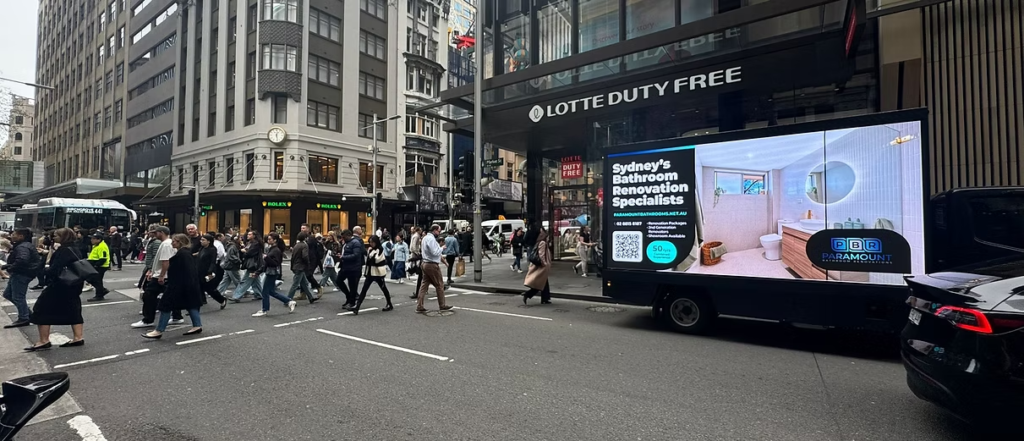
In the rapidly evolving world of marketing, out‑of‑home (OOH) advertising remains a powerful way to reach audiences in real-world contexts. Among OOH methods, billboard advertising mobile ads mounted on moving vehicles like trucks or vans, is emerging as a particularly effective and future‑ready medium. In this article, we explore the advantages of mobile billboards, why they outshine traditional static billboards, and how they align with evolving consumer behavior.
Mobility and Reach: Taking the Message Where the People Are
A key strength of mobile billboard advertising is its mobility. Unlike a static billboard that sits in one fixed location, a mobile billboard can travel through different neighborhoods, commercial districts, residential zones, and high-traffic zones in a single day. This mobility enables advertisers to reach a diverse, dynamic audience rather than being limited to whoever happens to pass a particular spot.
Because mobile units traverse multiple routes, they offer broad coverage — capturing attention across varied demographics, from office‑goers and shoppers to pedestrians and commuters. For brands aiming for fast and wide exposure (for product launches, events, or promotions), mobile billboard campaigns can deliver reach in hours rather than weeks or months.
Better Attention, Higher Recall and Engagement
One reason mobile billboard advertising works better than static displays is the human tendency to notice movement. A moving truck with a bold advertisement naturally draws the eye — it breaks the “visual routine” that passers‑by have with static ads.
Empirical studies confirm this advantage. Mobile billboard campaigns can achieve recall rates as high as 97%, significantly higher than many traditional static billboards. Some analyses also suggest mobile billboards produce 30,000–70,000 impressions per day per vehicle under certain conditions — a scale difficult to match with static placements.
Moreover, modern versions of mobile billboards — often using LED screens — allow dynamic visual content: bright graphics, animations, even interactive elements (such as QR codes), making them more engaging than static print ads. This dynamic content increases the likelihood that the ad will stick in viewers’ minds and triggers deeper brand recall.
Flexibility and Targeted Campaign Execution
Mobile billboard advertising provides marketers with a level of strategic flexibility that static billboards cannot match. Because the billboard is on wheels, advertisers can plan routes to target specific neighborhoods, events, or demographics — for example, driving through shopping districts during weekends, or residential areas during evenings.
This targeted placement allows campaigns to be optimized for maximal impact per rupee spent (or per impression). Rather than paying for a fixed placement with uncertain footfall, advertisers can choose times and routes that maximize exposure to their target audiences.
Additionally, many modern mobile billboard fleets come with GPS-tracking and analytics capabilities, enabling real-time campaign tracking, measurement of impressions, and assessment of engagement or recall. This measurability — rarely available with classic static billboards — makes mobile billboard advertising an attractive option for data‑driven marketers.
Cost-Effectiveness Compared to Traditional OOH
Mobile billboard advertising often proves more cost-effective than traditional billboard campaigns. While initial production and vehicle rental costs may seem higher, the ability to reach multiple high-traffic areas daily without paying for multiple static placements can reduce the cost per impression dramatically.
Smaller businesses, startups, or brands testing new markets can particularly benefit from mobile billboards, as campaigns can be scaled up or down with minimal logistical hurdles. Compared to renting multiple static billboards in key locations, a mobile unit can circulate through the same areas repeatedly at a fraction of the cost.
Adapting to Changing Consumer Behavior
Modern consumers increasingly ignore static ads due to overexposure. Mobile billboard advertising combats this by introducing motion and novelty into the marketing environment. Consumers are more likely to notice and remember moving advertisements, particularly when designs are vibrant, concise, and visually impactful.
Additionally, the rise of GPS-enabled devices and app-based route tracking means advertisers can use data to optimize mobile billboard placement and timing for maximum visibility. This alignment of technology, data, and mobility positions billboard advertising mobile as a truly forward-looking OOH strategy.
Conclusion
As marketers seek innovative ways to capture attention in crowded urban environments, mobile billboard advertising stands out as a flexible, cost-effective, and highly engaging option. With its combination of mobility, high recall, targeted reach, and measurable results, this medium is poised to dominate the future of out-of-home marketing. Businesses looking to adopt cutting-edge OOH strategies would do well to explore truck billboard advertising as a natural extension of this approach.